
- Q&A on c.a.r.e.
Online Q&A with Heike Kuhlmann
c.a.r.e. stands for Creativity, Attachment, Resilience, and Education. Cultivating care for oneself and others forms a vital foundation for relationships—both with ourselves and those around us.
Our training program equips participants with key insights from neuroscience, pedagogy, psychology, and somatics, focusing on the core of human coexistence: human development. These principles are designed to support professionals in therapeutic, educational, and social fields, while also offering tools for personal growth.
During this free online Q&A session via Zoom, you can ask questions about the content, practical aspects, and organization of the c.a.r.e. training program and meet some of the training team.
The training program begins on July 6, 2026 >> More information about the c.a.r.e. training program
The online information session is free, but we ask that you register in advance via the following link: https://us06web.zoom.us/meeting/register/x2d67MR5QlGpDtUabn35Wg
Ausführliche Seminarinformationen
200 UE / 6 modules / 4 somatic methods / 3 instructors
Curriculum
The C.A.R.E training consists of 6 modules and each module can be booked individually. You can join the ongoing modular training at any time.
Some of the modules are recognized as educational leave in Berlin.
Curriculum
Module 1 | Jul 06 - Jul 11, 2026 | Embryology
|
Module 2 | Jul 13 - Jul 17, 2026 | Infant movement development
|
Module 3 | Sep 28 - Oct 02, 2026 | Self-Other* - and interaction
|
Module 4 | Jan 04 - Jan 08, 2027 | Embodied Pathways
|
Module 5 | Mar 29 - Apr 02, 2027 | Motivation, Engagement & Vitality
|
Module 6 | May 03 - May 08, 2027 | Embodying Creation
|
For whom is C.A.R.E?
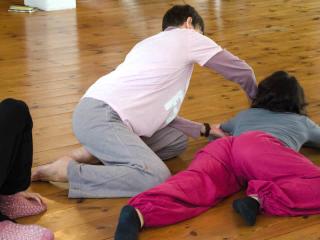
- Teachers, social workers, youth workers and parents who are looking for new ways to help children and young people grow and develop through physical experience and body awareness.
- Parents who want to better understand how they can promote their children's emotional and physical well-being through movement and mindfulness.
- Anyone who wants to learn how to find and support their own emotional and physical balance.
What are the key educational aspects of the C.A.R.E. program?
- Developmental foundations: C.A.R.E. begins with the observation of how humans develop from the earliest stages (prenatal, infancy, early childhood) and how movement and attachment influence learning. The neurobiological foundations of learning, such as the function of the nervous system and the development of trauma, form the educational cornerstones of the training.
- Learning through experience: Participants learn through embodied experience. Movement-based activities provide a deep understanding of developmental processes, while theoretical information accompanies their own learning and reflection process.
- Learning as a lifelong process: C.A.R.E. is aimed at those who wish to deepen their understanding of learning as an ongoing developmental process - be it in their work with children, adults or for their own personal growth.
Research-based and practice-oriented
Our C.A.R.E. program is based on years of practical experience and integrates proven approaches from various disciplines, such as Somatic Experiencing (SE), Body-Mind Centering®, Neuromotor Development Promotion INPP®, NARM, Feldenkrais and others. These methods are integrated with each other to promote a deep understanding of the connections between body, mind and development. They are based on the latest research and help to regulate the nervous system and understand the effects of trauma and early childhood development without focusing on the traumatic event itself.
Applied somatic methods of training
- IBMT (Integrative Bodywork- and Movement Therapy)
- Neurophysiological Psychology
- Feldenkrais
- Contact Improvisation
- Ideokinesis
- Body-Mind Centering®
- Dance
Graduation Requirements:
- Proof of 10 hours observation.
- One class presentation
- Case study or practical research, documented in an essay of maximum 3,000
General content:
Embryology- Tone
- Development of the vestibular system
- Reflexes
- Primitive reflexes
- Postural reflexes
- Human Movement Development
- Brain development
- development of the nervous system
- information processing
- physiological learning processes
- new versus re-learning
- creating a supportive space for learning
- dealing with resistance
- achievement evaluation
- age-appropriate mediation
- teenagers
- 8-11 (development of sexuality)
- 3-7/8 (Postural reflexes should be integrated)
- 0-3
- Games: Movement activities / Support / Touch
- Touch: as support not as correction /alternatives to touch
Subjects:
- Experiential Anatomy
- A variety of Somatic methods
- Context / practical application / practice fields
- Integration
- Hands on
- Case study discussions
Seminarleiter*innen
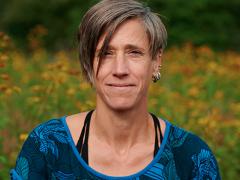
Heike Kuhlmann
MSME, BMC®-Practitioner, dancer, -educator, choreographer, MA Performance Studies/Choreography, Learner of the Discipline of Authentic Movement
Her somatic dance practice focuses on Body-Mind Centering®, Authentic Movement, and Contact Improvisation. In all these methods, Heike is interested in the process of human development. Taking structural conditions into account, Heike aims to support individuals through her work and thereby contribute to creating an environment where people can meet on equal footing. She facilitates somatic processes in individual sessions, courses, workshops, and training programs. Co-founder of the Working Group on Critical Somatics (AKS). Her artistic interests combine dance, activism, and somatics.
More information on: www.heikekuhlmann.net
Kosten
Anmeldeinformationen
Online