
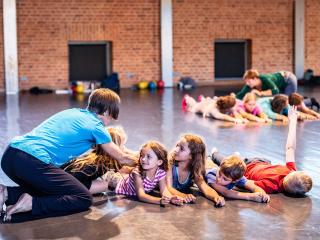
- Infant Movement Development
Module 2
The relevance for the human developmental process
This module invites you into the rich and intricate world of early movement in infancy — a time when the body begins to write its first language. Here, theory meets lived experience, as we explore how the movements of the first year quietly scaffold our later capacities: to think, to feel, to relate, to learn.
We trace the subtle threads of muscle tone, balance, and primitive reflexes, weaving them into a deeper understanding of how human beings grow, connect, and adapt. These early gestures — seemingly simple — are shaped by a living dialogue between inner impulses and outer surroundings. In this interplay lies the quiet poetry of development.
Through embodied exploration and attentive observation, participants begin to sense how movement reveals inner landscapes: needs seeking expression, capacities awakening, emotions stirring. These motions are not mechanical repetitions — they are relational acts, intimate negotiations with gravity, space, and the presence of others.
Participants are invited to witness and experience the emergence of foundational movement patterns — feeling how reflexes and postural adjustments guide the infant’s path toward interaction, learning, and autonomy. Through movement, we catch a glimpse of the architecture of becoming: a living mirror that reflects needs, potential, and the first steps toward coherence.
A central thread of the module is cultivating the art of observation — not only with trained precision, but with open, nonjudgmental awareness. This perceptual skill is vital for clinicians, educators, therapists — and for anyone seeking a deeper, more compassionate relationship with their own body and others.
This is not only a matter of observation — it is a quiet return: to the body’s wisdom, to the rhythms that shaped us, to the silent resilience seeded in our first movements.
In an age of distraction, disconnection, and growing developmental strain, these primal patterns offer a path back to wholeness — clear, grounded, and alive.
Key Topics of the module:
- Muscle tone and movement development in the first year
- Foundational movement sequences: Roll / Yield / Push / Reach / Pull
- Primitive reflexes and postural reflexes
- The balance system (vestibular system)
- Brain and visual development
- Movement observation and analysis
- Contextual applications, practical examples, and case studies
- Interaction and attunement with caregivers
Ausführliche Seminarinformationen
Seminarleiter*innen
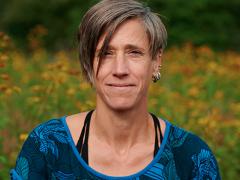
Heike Kuhlmann
MSME, BMC®-Practitioner, dancer, -educator, choreographer, MA Performance Studies/Choreography, Learner of the Discipline of Authentic Movement
Her somatic dance practice focuses on Body-Mind Centering®, Authentic Movement, and Contact Improvisation. In all these methods, Heike is interested in the process of human development. Taking structural conditions into account, Heike aims to support individuals through her work and thereby contribute to creating an environment where people can meet on equal footing. She facilitates somatic processes in individual sessions, courses, workshops, and training programs. Co-founder of the Working Group on Critical Somatics (AKS). Her artistic interests combine dance, activism, and somatics.
More information on: www.heikekuhlmann.net
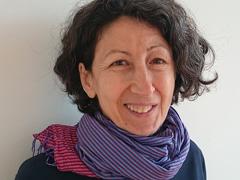
Adalisa Menghini
Teacher, choreographer, performer
Adalisa studied at the S.N.D.O in Amsterdam, after which she completed her M.A. in Neurophysiological Psychology. She is a teacher of the Feldenkrais Method. She works with professional and non-professional dancers, children and seniors. She was nominated twice as best choreographer of the "Giocabriga". In collaboration with K. Wickenhäuser, she has brought performances with school children to museums. Twice they have won the "Kinder zum Olymp!" award. She teaches at the Tanzfabrik, the Somatic Academy Berlin and at the Berlin University of the Arts.
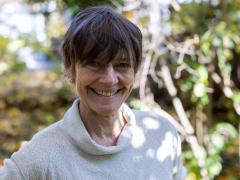
Ka Rustler
Ka Rustler has been performing, researching and analyzing somatic practices and their embodiment in movement, choreography and therapy for over 30 years. BMC® Teacher
Teilnehmerstimmen
»What better way to connect to your child than through contact improvisation?!«— Naomi // Berlin
»A space for gentle growth and mindful development! With and by loving, professional companions who work with the depth of their own experience!«— Na Mi // Berlin
»For me, the Somatic Basics Training is a year of experience, research and learning that connects me with myself and the world again and again. It inspires and accompanies me in my own search for meaning. «— KS // Berlin
»Somatic teaches me to be mindful with my own body and myself. It leads me to an unbiased consideration of my needs and feelings. You could also call it self-love. «— M.M. // Berlin
»I have become more sensitive to my body and its structures. I identify my body more than before as my home. «— TL // Berlin
»Somatic gives me more awareness and thus love and attention for my body. «— Henriette // Berlin
»Thank you for the wonderful journeys through the inner and outer landscapes.«— Miriam // Berlin
Anmeldeinformationen
BerlinSomatische Akademie Berlin
Paul-Lincke-Ufer 30
10999 Berlin | side building
1st backyard
4th floor
- Full Price: 690.00 EUR
This module is part of the professional training c.a.r.e and seperatly bookable as well:
Infant Movement Development
DE+EN | 5-day workshop c.a.r.e
July 13-17, 2026
